Empowering climate-friendly cookstove producers and driving sustainable market growth in Kenya and Senegal
While access to clean cooking has increased in recent years, approximately 2.1 billion people still rely on traditional fuels such as solid biomass, kerosene, or coal as their primary cooking sources.
Improved Cookstoves (ICS) are an alternative to traditional stoves and can serve as a transitional step toward cleaner technology. The increased adoption and use of ICS can help mitigate greenhouse gas emissions by reducing them on the consumer side. However, access to ICS is hindered primarily by low productivity and weak distribution channels, as is the case in Kenya and Senegal.
To promote climate-friendly cooking, the Green Climate Fund (GCF) has partnered with the governments of Kenya, Senegal, and Germany on a project to expand access to ICS. Backed by GCF, the Promotion of Climate-Friendly Cooking: Kenya and Senegal has developed a professionalisation approach to tackle access barriers in these countries.
Based on specific market preconditions, the professionalisation approach encompasses key elements to enable local ICS producers and distributors, thereby accelerating and driving the scaling of clean cooking access and fostering sustainable market growth. Enhancing the productivity of ICS producers brings the market to a new level of scale, reducing production costs and, consequently, the stove price for the end user, making clean cooking more affordable in Kenya and Senegal.
Key achievements
Implemented by GIZ and executing partners on the ground, the project has yielded strong results in Kenya and Senegal.
- More than 5.7 million tons of CO₂ cumulatively reduced to date (5.711.639 tCO₂eq, based on the “annual in use methodology”)
- Over 4.7 million ICS produced and sold between 2020 and 2025 (4.709.308, additional sales, attributable to the project)
- 60 business-class producers supported (monthly capacity >1,000 ICS)
- 146 intermediate professional producers supported (capacity 100–1,000 ICS/month)
- 3,466 full-time jobs created in 2025 alone
These results significantly contribute to the climate targets in Kenya and Senegal’s Nationally Determined Contributions (NDC).
Transforming and scaling up local producers
The project’s centrepiece is the Professionalisation Approach, which transforms artisanal ICS producers into intermediate and business-scale enterprises. Through performance-based support packages, local producers receive 'professionalisation kits' with tools, machinery (e.g., welding equipment), as well as comprehensive technical and business training modules.
The professionalisation approach covers health and safety, bookkeeping, access to finance, and marketing strategies. Additionally, the project supports the enhancement of distribution chains, providing business-to-business support and ensuring clean cooking technologies reach even the most remote regions.
Mbathie’s story
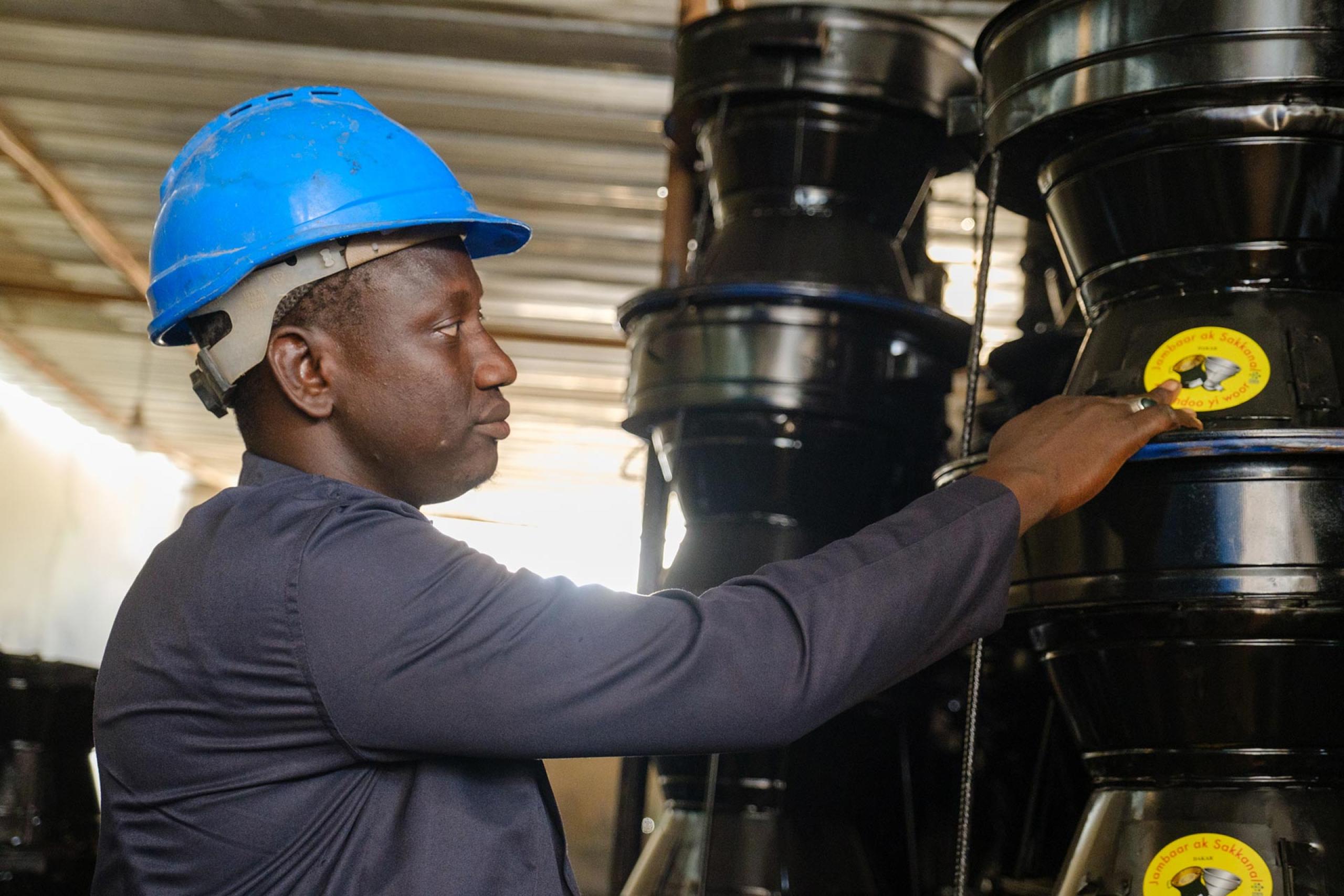
Mbathie Sow, showcasing his stoves, as well as the label for marketing, at his new workshop in Dakar, Senegal.
One of those producers is Mbathie Sow, who has been running his business in Dakar, Senegal, since 2012. Initially, he produced around 600 units per month. However, with project support and training, Mbathie has successfully scaled up his production. With 1,200 ICS units now distributed per month, he has expanded his distribution network into remote areas and hired seven new employees, creating opportunities for young people in Dakar. By becoming a business-class producer, he has access to financing opportunities, which opens new horizons. As a next step, Mbathie Sowe plans to invest in online marketing through social media to expand his supply network.
“Now I transport more than 400 ICS per trip to the city of Ziguinchor since I was able to increase my production; so I need to combine car hire with the transport by van that was provided by the project.”
Naomi’s story
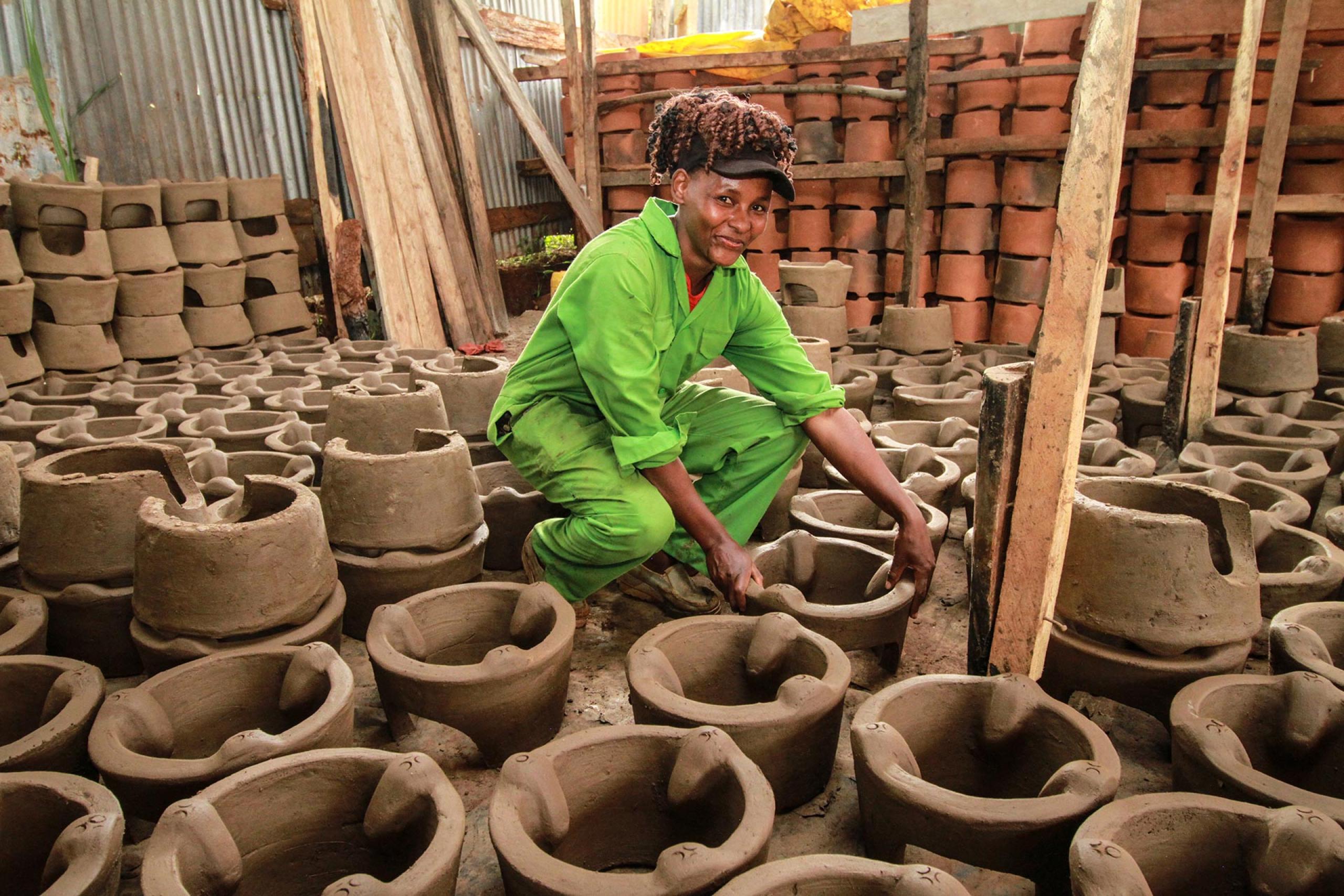
Naomi Ngotho showcasing the freshly made ceramic liners in her ICS workshop in Murang’a County, Kenya.
In Murang’a County, Kenya, Naomi Ngotho has been in business since 2020, producing around 50 ICS per month. Her entrepreneurial spirit, combined with the support she received from the professionalisation kit, has enabled her to rapidly transition from small-scale artisanal production to a more professional level, where she has been able to scale up her productivity. As a result of this development, she hired six new employees, most of whom are women. But Naom's vision doesn't stop there; she has ambitious plans to broaden her market reach and put herself on a strong path toward business-class operations.
“Before, we used to produce 50 stoves per month, but currently, we produce more than 200 stoves. When I started, I had no home; now I own a home, and my children go to the best school. It’s all because of the hard work I put into this project.”
Bruce’s story
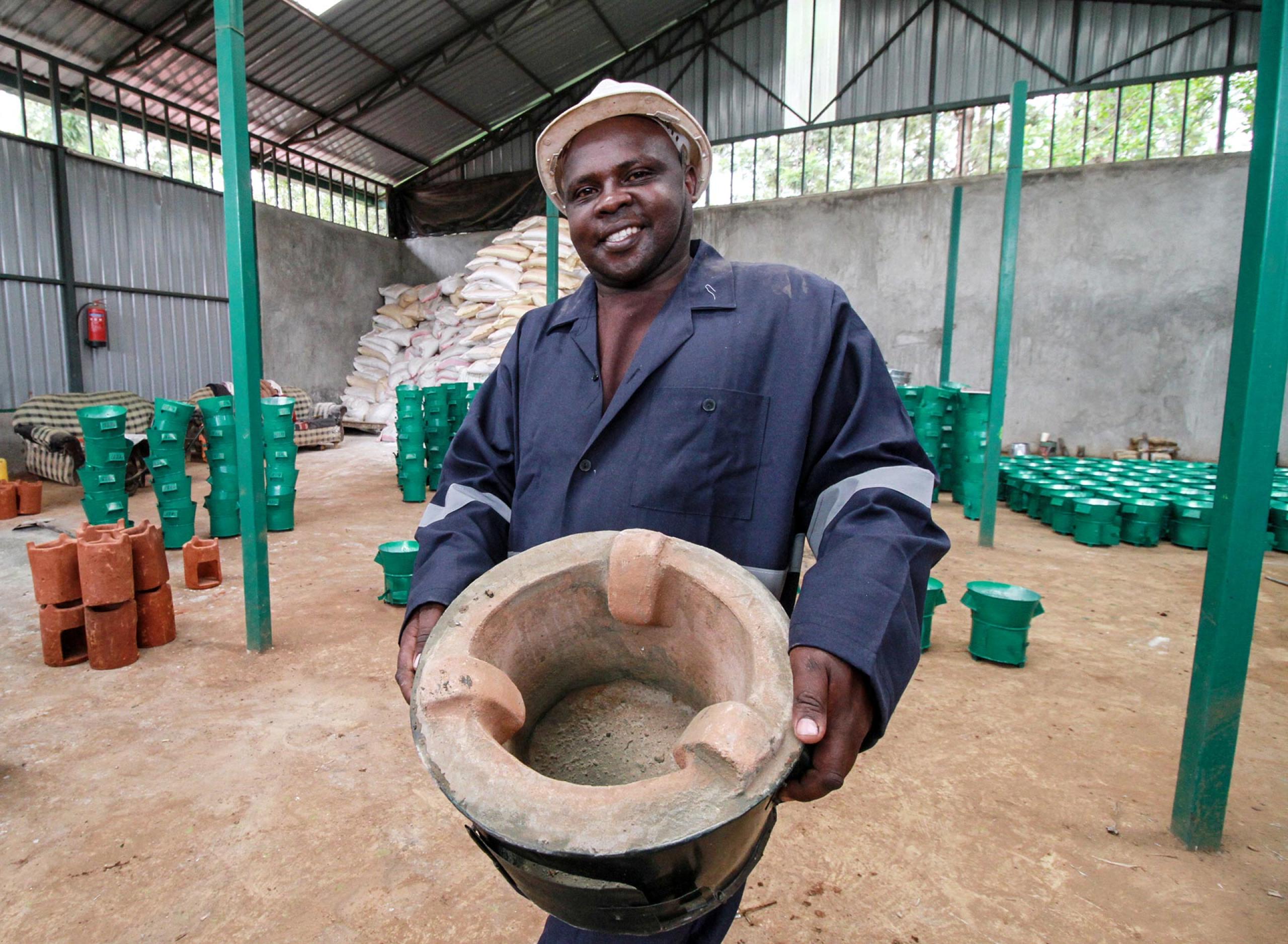
Bruce Kimathi showcasing a stove produced in his new ICS workshop facility next to his old workshop in Tharaka-Nithi County, Kenya.
Bruce Kimanthi has been operating at business-class levels for a while. He launched his stove production business in 2008 in Tharaka-Nithi County, Kenya, leveraging his background in ceramics and studies at a polytechnic university. Bruce began with a monthly production of 2,000 liners. Since receiving training in supply chain management and marketing, his business has expanded, now producing 5,000 liners per month. The expansion was also made possible due to another ICS workshop in which he participated. It enabled the mechanisation of ICS production processes and provided him with more storage space to deliver larger order quantities. Looking to the future, Bruce aims to explore additional energy-saving solutions in the market.
“The project introduced us to a spraying machine. Before, you could paint 50 stoves per day, but with spray, you can do up to 500 stoves.”
Ndeye Soukeyna Sene’s story
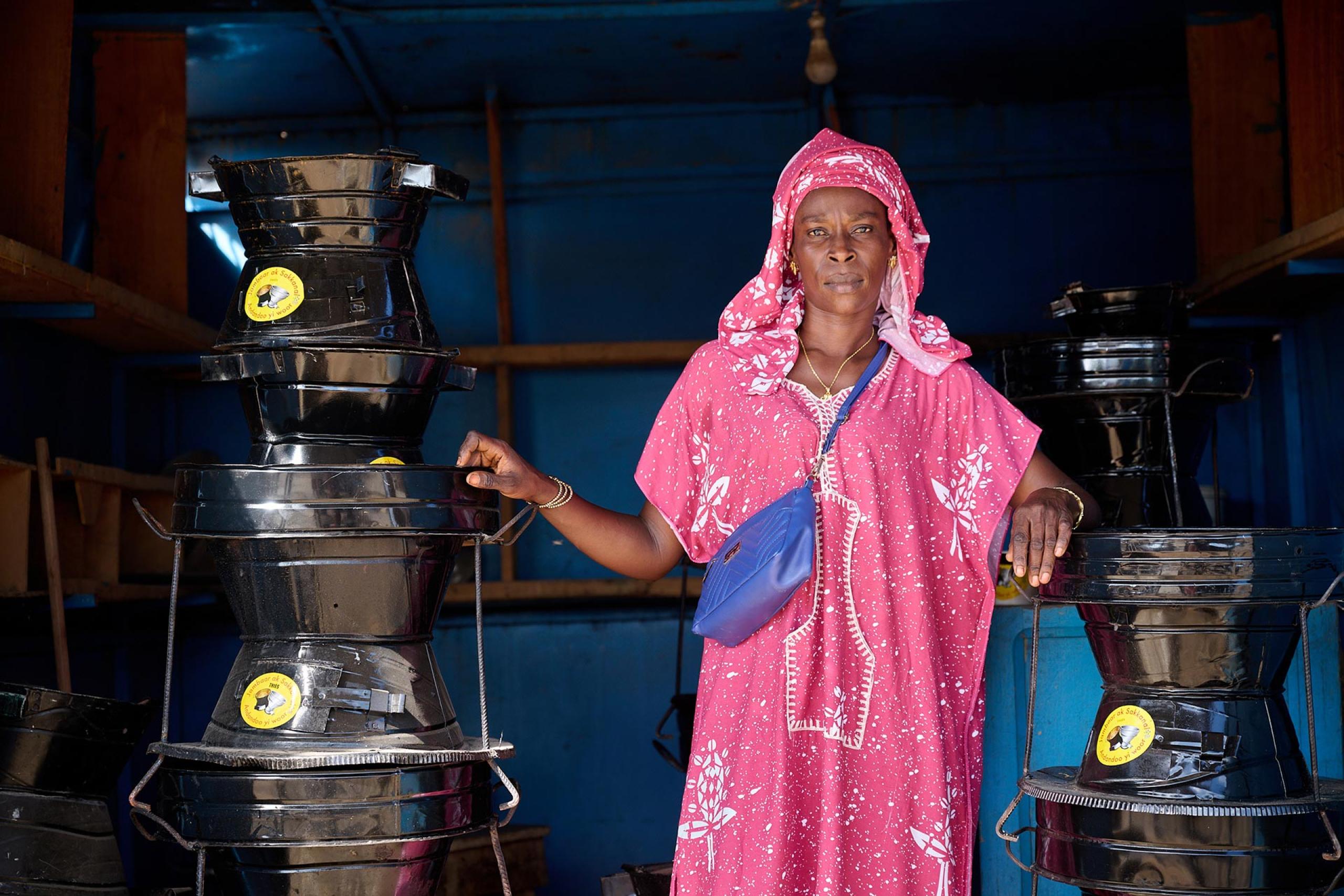
Among the women entrepreneurs supported by the project is Ndeye Soukeyna Sene, who has been selling improved cookstoves in Mbour, Senegal, since 2015. With project support, including training in marketing, business management coaching and personal development sessions, as well as a 10-stove starter kit, she was able to significantly strengthen her sales activities. These measures enabled her to invest in sales events and to employ three additional women as sales agents. As a result, her monthly sales increased from five improved cookstoves to more than 120.
Building on this success, she plans to further expand her distribution network using her own resources, particularly in the sub-region, including The Gambia. In parallel, she has reinvested part of her profits into additional training and the launch of a complementary business focused on the production and sale of soap, further diversifying her income sources.
For more information about the professionalisation approach: Guide to the professionalisation approach. This guide introduces the professionalisation approach, discusses preconditions, presents key design elements, provides implementation advice and shares early lessons learned.
The bigger picture
Beyond economic and environmental impacts, the project drives significant social development. At the end of the project, approximately 3.4 million (3,441,295) predominantly rural households are expected to directly benefit. Among these households, almost one-third are headed by women (1,080,684), highlighting the positive impact on women’s empowerment. Additionally, over 13 million children (13,083,204) are expected to benefit from improvements in health and educational outcomes.
The project’s outcomes will also reduce the probability of respiratory diseases and the time spent collecting fuelwood and cooking meals. This has a positive indirect effect, allowing more time to be spent on income-generating activities and on children's school attendance and development.
By empowering local producers and expanding access to clean cooking solutions, the project not only strengthens economies but also improves livelihoods, health, and opportunities—creating lasting change for both people and the planet.
“Promotion of Climate-Friendly Cooking: Kenya and Senegal” is cofinanced by the Federal Ministry for Economic Cooperation and Development (BMZ), the Green Climate Fund (GCF), Kenya’s Ministry of Energy, and Senegal’s Ministry of Petroleum and Energy and Ministry of the Environment and Sustainable Development. The project is implemented as an associated project of the Energising Development (EnDev) Programme under the EnDev Partnership umbrella.
This story was co-authored by GCF and GIZ, with thanks to GIZ for the original version.